
Material selection
Material selection for tubing and fittings
When should a designer specify 316L, 6Mo or super duplex 2507? Start with the exposure, then follow the material decision through the tube, ferrules, valve and supports.
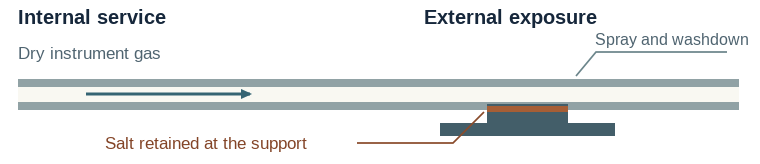
A dry gas inside the tube can leave the outside wall exposed to warm, trapped seawater. Define the wetted and external environments separately before specifying the grade.
Alloy comparison
Which failure mechanism matters here?
Make two descriptions of the line. On the inside, identify the fluid, impurities, temperature and upset chemistry. On the outside, record spray, deposits, drying cycles, crevices and contact with supports. Then compare candidates against the more demanding location.
| Grade and family | A reason to evaluate it | A condition to resolve |
|---|---|---|
| 316L · UNS S31603 Austenitic | A familiar starting point for many clean, moderate environments. The lower carbon content helps limit sensitisation associated with welding. | Chlorides can concentrate under a support or damaged insulation. Check temperature and wetting history before selecting it for that exposure. |
| 6Mo · example UNS S31254 High-alloy austenitic | A candidate when chloride pitting or crevice corrosion drives the choice. The cited 254 SMO data describe one specific 6Mo grade. | State the exact UNS and product specification. Verify the tube, fitting and weld consumable combination separately. “6Mo” describes a family. |
| 2507 · UNS S32750 Super duplex | High mechanical strength and resistance to localised corrosion can be useful in demanding chloride service. | Check fabrication, welding procedure, tube hardness and the fitting manufacturer’s approved combination. A higher yield strength does not establish a joint rating. |
Record design pressure and minimum and maximum metal temperatures alongside corrosion duty. A material can be a good corrosion candidate while the proposed tube condition or valve configuration remains unsuitable.
Tube to valve
Follow the material through the joint
Consider an instrument-gas branch running from an enclosed module onto an exposed deck. After washdown, salts remain beneath a support. The dry internal service and the sheltered external crevice now place different demands on the same tube wall.
A component-by-component review
- Tube and welded transition
- UNS, product form, OD, wall and tolerances. Verify surface and delivery condition, bend or weld procedure, post-fabrication condition and pressure design.
- Fitting body, nut and ferrules
- Record the manufacturer’s approved combination for the tube grade, measured or guaranteed hardness, OD, wall and delivery condition. Carry the applicable hardness scale and limit onto the purchasing specification. High-strength tube may require a different qualified joint from the one previously used on 316L.
- Valve trim and seals
- Identify body and stem, seat or tip, springs, packing and static gaskets. Check the actual wetted materials against the fluid, temperature, cycling and cleaning media.
- Support and exposed hardware
- Map dissimilar-metal contact, deposits, drainage and the ability to inspect behind the clamp. Changing only the tube can leave the initiation site or a vulnerable fitting in place.
Decision in the example
Compare a change in support geometry and exposure with a change in alloy. If the crevice will stay wet, evaluate the higher-alloy tube and the complete fitting interface. Record why the selected combination addresses the mechanism.
Why a body stamp is useful
BMT R38 lists body marks including 316, 316L and 6MO. Its table shows that 316 can also denote dual-certified 316/316L stock. Use the traceable heat record for the ordered grade. A body mark cannot identify the chemistry of a separate ferrule, spring or valve stem.
Evidence at handover
Match the material record to the part
A purchase line that says “stainless steel, suitable for offshore service” leaves the controlling alloy, condition and exposure unstated. Make the bill of materials and the inspection evidence describe the same assembly.
| Record | What it should let a reader verify |
|---|---|
| Material schedule | Exact grade or UNS, product specification and condition for the tube and relevant pressure-containing or wetted parts. Identify any permitted substitution explicitly. |
| Traceability | Link the delivered item or batch to its heat and the required inspection document. Where EN 10204 type 3.1 is specified, compare the declared chemistry and test data with the order. |
| Joint qualification and rating | Keep the manufacturer’s applicable tube condition and compatibility limits, dimensions, pressure–temperature basis and any project-specific evidence for the assembled joint. |
| Fabricated condition | Identify the bending or welding basis, consumables, inspection and how the original material identity was maintained after cutting or fabrication. |
A type 3.1 certificate can support a material claim for the identified product. The leak performance of a completed fitting or valve needs assembly-level evidence. Keep both records with the line tag so the next replacement can be checked against the original decision.