
Check valve selection
Check valve cracking pressure vs. pressure drop
A water branch can develop 2 psi across its check valve when the pump starts. The spring is marked 1/3 psi. It sounds like plenty of margin until you read what the nominal number represents.
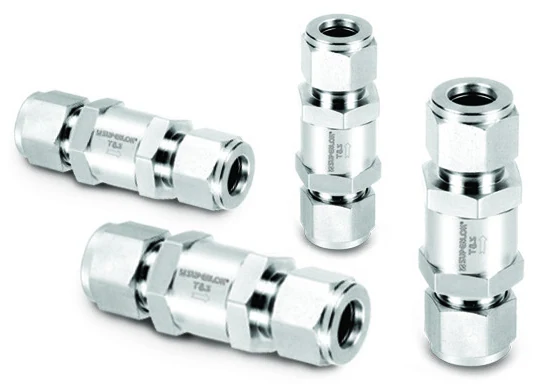
Cracking pressure describes the first detectable forward flow. Pressure drop at the specified flow and the differential needed to reseal are separate requirements. For the BMT SHCV 1/3 psi spring, the published cracking range extends to 3 psi.
Reading the spring data
A nominal spring value has a range
A check valve responds to differential pressure. Before the poppet lifts, compare inlet pressure with outlet pressure at the valve. As flow increases, the opening and hydraulic losses change. A system’s operating pressure tells you little about whether enough differential exists at the valve.

BMT lists a maximum Cv of 1.8 for SHCV2 with 12 mm tube ends. This describes capacity at the stated maximum opening. Near first lift the effective opening is smaller. A calculation made with maximum Cv can understate the loss at low lift.
| Condition | Data to read | Decision |
|---|---|---|
| First forward flow | Cracking range of the spring | Will the least favourable unit open? |
| At target flow | Flow versus Δp for that valve and spring | Can the line deliver its duty? |
| Flow falls or reverses | Reseal value and pressure direction | Can the element return to its seat? |
Worked selection
A 2 psi start-up margin on a water branch
At start-up, gauges at the valve ports read 20 and 18 psig. Their difference is 2 psi. For an SHCV2 with a nominal 1/3 psi spring (code 0.3P), BMT gives a cracking range of 0–3 psi. With forward differential defined as inlet minus outlet, the available value is +2 psi. The upper cracking value is +3 psi. That leaves a 1 psi shortfall against the upper limit before any flow-capacity calculation.
Then check the required flow
Suppose the branch must pass 4 L/min. Establish the pressure available at that flow after the losses in the rest of the branch. Obtain a flow-versus-differential curve or test point for the selected SHCV size, spring and fluid. The spring marking alone gives no flow rate.
When the pump stops
For the same spring, BMT lists 6 psi back pressure in the minimum reseal column at the reference condition. With the same sign convention, 6 psi of downstream backpressure is −6 psi differential. Check the available reverse differential and the required seat leakage criterion. The table entry is a published test condition, not an exact switching point for every valve. Record which side is higher for both opening and reseal.
SHCV 0.3P in the worked example
- Available to open
- 2 psi forward
- Upper crack value
- 3 psi forward
- Listed reseal
- 6 psi reverse